Intention Is All You Need
On the software systems of the future

Systems of shared understanding
At their core, businesses are resource allocation and optimization machines. Accordingly, the most valuable software systems are those that enable the deployment and management of these resources. Historically, these have been called systems of record. They own the core objects that a business runs on. These objects represent a shared understanding across the organization, and allow for the management of resources deployed against complicated, long running, and cross functional workflows.
Salesforce owns the customer. Workday owns the employee. ServiceNow owns the technology. Contrary to popular belief, these aren’t just databases¹. They’re representations of organizational truth around what a customer is, what an employee is, what a technology asset is. They represent how each is defined, how each is measured, the set of potential states, and how each is managed. As I’ve written previously, enterprise value rises as the objects owned are more critical to running the business. Own the objects, own the workflow, own the ecosystem, own the value.
This shared understanding is important because it’s what makes coordination within an organization possible. Thousands of people can operate in concert because they’re working off the same map: the same Leads, Opportunities, Accounts, Contacts, Tickets, Cases. The application UI makes these objects comprehensible to people, and through comprehension, governable. The complexity of coordination scales with the organization, which is why seats have been an agreed upon way to measure value: the more seats, the more human complexity being managed, the more it costs. And presumably, the more benefit it drives.
People are left to fill in the gaps between these objects on their own: using judgment, previous experience, and corporate training to do the work that the record alone can’t prescribe. The system of record gives you a frame of reference for what matters to the business. People are left by and large to figure out what to do about it.
The evolution of coordination
As already established, resource allocation is the core challenge of a business. Historically, the resources to be allocated were primarily people. But if you’ve been paying attention over the last few years, you’ll know that we now have a new resource to deploy: the agent. And these agents fundamentally change the equation, because they are infinitely scalable, programmable, and if you believe the marketing, will soon be infinitely capable².
In the current world, you can think of the majority of work being done as analog, in a sense. People taking actions with their hands: logging in, clicking, typing, updating fields. Agents on the other hand, are digital³. When agents enter the picture, the question shifts from “how do we give people a shared map to decipher?” to “how do we give agents and people a shared destination to work towards?”
Shared organizational understanding of objects is necessary but no longer sufficient. What the customer is matters less than what needs to happen with the customer. The current system describes state.
What you’ll increasingly need is a system that defines and manages intent: a shared understanding of the outcome the organization is pursuing, and the plan(s) to get there.
Everyone wants outcomes, and outcomes require action. Action requires intent. And intent requires context, but we’ll get to that later.
From shared records to shared intent
The most valuable systems in the coming intelligence age won’t be the ones that define and store the canonical core objects, though that’s a prerequisite. The systems that win will be the ones that create and manage the shared intent related to those objects— what needs to happen to the customer, the candidate, the financials— and orchestrate agents and people to make it a reality.
Close this customer. Resolve this issue. Hire for this role. These intentions drive state change between core objects and the relationship between the company and those objects. Every other system, every agent, every person revolves around that intention and, by association, orbits the system that owns it.
This represents a fundamental shift in the gravity of software systems. Systems of record have historically created gravity by owning shared understanding of objects. The most valuable systems in the future will create gravity by owning shared purpose.
And this gravitational pull will be far greater than that of the systems of the past, because it will now both define, coordinate, and autonomously accomplish end to end workflows.
The map is not the territory
The objects in today’s systems are maps: simplified, coarsely defined representations of reality. A Lead record compresses a living, breathing human with complex motivations into a handful of fields. An Opportunity compresses months of conversations, relationships, and negotiations into a stage and a dollar amount. This compression was necessary because people can’t process the full picture. You had to give them something manageable.
Agents don’t have this limitation. They can ingest and make sense of the territory itself: the call transcripts, the email and slack threads, the meeting note. All the unstructured data that’s been accumulating for years but was too dense for people to synthesize. Agents can create far more granular, tailored, and real-time understanding than any object ever could. And they can do it continuously, updating as the territory evolves.
This subtle point has enormous implications. The systems of the past compressed reality into objects because people needed simplification. The systems of the future let agents work with reality directly, and surface what matters to people when they need it.
The map was a required compromise. Agents can navigate the territory.
Architecting for intention
The application architectures of today were built to give people maps. A user interface that exposes objects that persist object state in a backend. But agents can traverse the territory, on the road to outcomes, guided by intention.
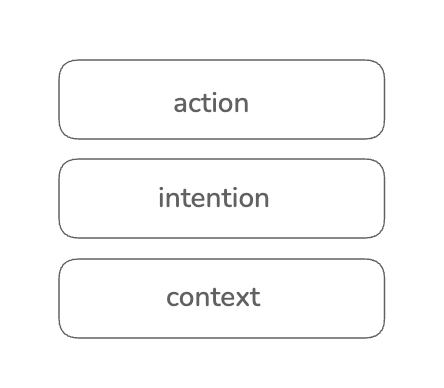
An intention-centric architecture puts objectives, not objects, at the center. You could simplify this new architecture to three layers: context at the bottom, intention at the center, and action at the top. Put differently, context provides the current state, intention provides a desired future state, and agents (both AI and human) are orchestrated to get you there.
Intent isn’t a hand-wavy goal statement on a slide. It’s structured: a specific outcome, the constraints around it, the assumptions it’s based on, and the evaluations of the outcomes. A goal you can’t decompose into tasks, measure against outcomes, or adjust based on new information isn’t intent, it’s a pipe dream.
The specificity of the intention determines the ambition of the work you can delegate to agents. This is where creating and providing tailored context becomes high leverage.
“Close this customer” is okay, but if you can determine that the plan should be “close this customer by demonstrating ROI in their compliance workflow, leveraging the CFO relationship, before FY budget cycle” is dramatically more useful to a system that needs to deliver on outcomes.
The value of the system in the future will be increasingly derived from its ability to accomplish objectives. Today most AI applications are limited to a Q&A style of task delegation by a human. Where these systems truly become transformational is when they do not just execute on tasks, they propose them.
Feeding the machine
The economics of work are inverting. Execution has historically been where the majority of resources were spent. Create a plan over the course of days, execute on it over weeks, months, and quarters. Agents present the opportunity to compress this by orders of magnitude, and invert the bottleneck from doing to defining the work to be done.
This creates a mismatch of cadences: agent execution scales infinitely, but human task generation does not.
In solving this mismatch, the software systems of the future built with an intention-oriented architecture will become dominant. This system isn’t an execution engine for human-defined tasks. It creates and closes its own loops: observe the current state, define the objective, plan, act, evaluate the outcome, and adjust. The system builds and feeds itself.
The more context the system has, and the better it can make sense of it, the better the tasks it generates. The better the tasks, the better the outcomes. The better the outcomes, the more context it produces. This creates a flywheel, and a flywheel generates velocity.
When moving at unbounded speed, small errors can compound and send you disastrously in the wrong direction. But get the objectives and iterative loops right, and you can move with a velocity that was previously unfathomable.
A blueprint for the future of work
For an example of the future, look no further than software development itself. It’s a clear proof point we have yet, and the reason maps directly to the argument above: code is the one domain where the territory is already digital and legible. The codebase is a rich, living representation of reality that agents can work with directly. No compression into objects required.
You can infer a degree of intention directly from the code, and supplement it with direct interaction with its engineer. The system plans, presents the plan, the user confirms or restates, and the loop continues. Plan. Present. Confirm. Execute. Loop. There are already teams shipping entire products with zero manually written code⁴. The engineers’ job isn’t to write code. It’s to design the environment, specify intent, and build feedback loops.
The coding market is unique because it’s inherently legible to agents, and has built in agent abstractions. Other domains must discover the abstractions, and create legibility. The platforms that do so will win.
Compounding value
For thirty years, value has accrued to the systems that owned the shared understanding of core objects. The next thirty years will belong to the systems that own the shared intent that’s required to orchestrate action and outcomes.
In doing so these systems will create even stronger gravity, because they don’t just provide a fuzzy description of reality, they will define, coordinate, and accomplish the work to be done.
The existing application stack doesn’t disappear, but it does get subordinated. Today’s systems of record, data platforms, applications, and agents become inputs that feed a system organized around something fundamentally different: an outcome.
We’re moving from objects to objectives. From records to intentions. From coordinating people to coordinating everything.
Note: you can find this post on twitter if you’d like to join the discussion there.
¹ Sure, whatever, maybe it’s technically a database. But so is literally everything, by that definition.
² I personally find the “country of geniuses in a datacenter” to be an extremely helpful metaphorical mental model for thinking through the ramifications and opportunities in applied AI.
³ Pun intended.
⁴ We’re seeing increasingly more examples of this, as evidenced by OpenAI, Spotify, and at the sake of editorializing, confirmed by my own experience.